

Your first chance to sign up (Initial Enrollment Period) is generally when you turn 65. This is called your Initial Enrollment Period. It lasts for 7 months, starting 3 months before you turn 65, and ending 3 months after the month you turn 65.
Once your Initial Enrollment Period ends, you may have the chance to sign up for Medicare during a Special Enrollment Period (SEP). If you're covered under a group health plan based on current employment, you have a SEP to sign up for Part A and/or Part B anytime as long as:
- You or your spouse (or family member if you're disabled) is working.
- You're covered by a group health plan through the employer or union based on that work.
You also have an 8-month SEP to sign up for Part A and/or Part B that starts at one of these times (whichever happens first):
- The month after the employment ends
- The month after group health plan insurance based on current employment ends
Usually, you don't pay a late enrollment penalty if you sign up during a SEP.
Part A premiums
If you buy Part A, you may pay a premium. If you paid Medicare taxes for less than 30 quarters of your work career, the standard Part A premium is $518 for 2025. If you paid Medicare taxes for 30-39 quarters, the standard Part A premium is $285. If you paid Medicare taxes for 40 or more quarters, there is no Part A premium.
In most cases, for those folks subject to a premium, if you choose to buy Part A, you must also have Medicare Part B (Medical Insurance) and pay monthly premiums for both.
If you aren't eligible for premium-free Part A, and you don't buy it when you're first eligible, your monthly premium may go up 10%. You'll have to pay the higher premium for twice the number of years you could have had Part A but didn't sign up.
Example
If you were eligible for Part A for 2 years but didn't sign up, you'll have to pay the higher premium for 4 years. Usually, you don't have to pay a penalty if you meet certain conditions that allow you to sign up for Part A during a special enrollment period.
Part B premiums
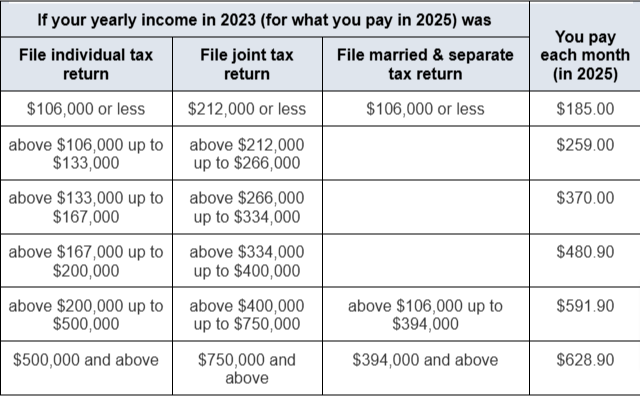
Since 2007, beneficiaries with higher incomes have paid higher Part B monthly premiums. These income-related monthly premium rates, which affect 7 percent of people with Medicare, are shown in the following table:
2025
The standard Part B premium amount in 2025 will be $185 (or higher depending on your income). You'll pay the premium amount in the right column depending on your 2023 annual income, as follows:
States have programs that pay some or all of beneficiaries' premiums and coinsurance for certain people who have Medicare and a limited income. Information is available at 1-800-MEDICARE (1-800-633-4227) and, for hearing and speech impaired, at TTY/TDD: 1-877-486-2048.
When you're first eligible for Medicare, you have a 7-month Initial Enrollment Period to sign up for Part A and/or Part B. If you aren’t automatically enrolled, you can sign up for free Part A (if you’re eligible) any time during or after your Initial Enrollment Period starts. Your coverage start date will depend on when you sign up. If you have to buy Part A and/or Part B, you can only sign up during a valid enrollment period.
In most cases, if you don’t sign up for Medicare Part B when you’re first eligible, you’ll have to pay a late enrollment penalty. You'll have to pay this penalty for as long as you have Part B and could have a gap in your health coverage. Your monthly premium for Part B may go up 10% for each full 12-month period that you could have had Part B but didn't sign up for it. Also, you may have to wait until the General Enrollment Period (from January 1 to March 31) to enroll in Part B. Coverage will start on the first of the next month.
Medicare Part D Prescription Drug Coverage
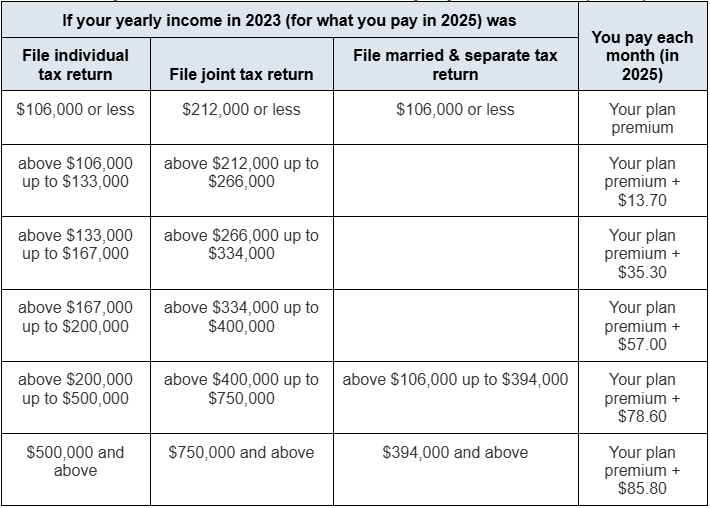
The standard Part D prescription drug premium amount in 2025 will depend on your 2023 annual income. There are many individual prescription drug plans available with varying benefits, copays, formularies and premiums. Also, there are many individual Medicare Advantage plans available. In addition to the stated premium, you may pay an extra amount as follows:
Monthly Plan Premium Income-Related Monthly Adjustment Amount (IRMAA)
For prescriptions, your plan may have a deductible but after satisfying that, you will pay copays until you reach an annual maximum of $2,000. After that level, covered medications can be obtained with $0 copay. Certain people pay only a portion of their Medicare drug plan premiums and deductibles based on their income level. In 2025, you may qualify for Extra Help if you have up to $22,590 in yearly income ($30,660 for a married couple) and up to $17,220 in resources ($34,360 for a married couple). If you don't qualify for Extra Help, your state may have programs that can help pay your prescription drug costs. Contact your Medicaid office or your State Health Insurance Assistance Program (SHIP) for more information.
Information presented here is courtesy of the Center for Medicare and Medicaid Services.

Insurance Needs Assessment: When You're Newly Married

Stay Safe with a Business Owner's Policy
